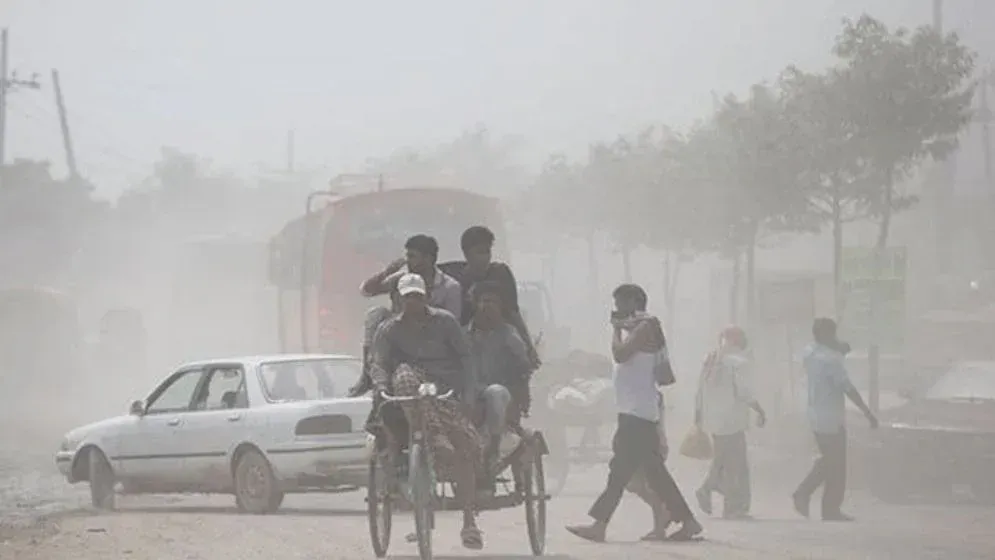
Bangla Press Desk: Air pollution levels are steadily rising in cities across the globe due to climate change and ongoing development activities. Amidst this situation, Lahore, Pakistan, tops the list of cities with the most polluted air, recording an air quality score of 201. This level of air quality is considered "very unhealthy" for residents. Meanwhile, Dhaka's air has remained unhealthy for the past few days; today, the Bangladeshi capital ranks ninth on the list with a score of 158. This air quality level is classified as "unhealthy."
This information was obtained on Tuesday (October 13) from the index maintained by IQAir, a Swiss-based air quality monitoring organization.
According to IQAir's Air Quality Index, Lahore, Pakistan, holds the top spot among the world's most polluted cities with a score of 201—a level deemed "very unhealthy" for the public. Singapore ranks second with a score of 194, followed by Delhi, India, in third place with the same score. Hanoi, Vietnam, ranks fourth with a score of 186, while Kolkata, India, ranks fifth with a score of 179.
Under IQAir's criteria, an air quality score between 0 and 50 is considered "good," while a score between 51 and 100 is deemed "moderate" or "acceptable." A score ranging from 101 to 150 is classified as "unhealthy for sensitive groups."
Scores between 151 and 200 are considered "unhealthy," while those between 201 and 300 are labeled "very unhealthy." Any score above 301 is classified as "hazardous."
In Bangladesh, the AQI is determined based on five specific pollutants. These include particulate matter (PM10 and PM2.5), NO2, CO, SO2, and ozone (O3).
A report by the Department of Environment and the World Bank in March 2019 identified three primary sources of air pollution in Dhaka: brick kilns, vehicle emissions, and dust from construction sites.
According to the World Health Organization (WHO), air pollution has led to increased mortality rates from stroke, heart disease, chronic obstructive pulmonary disease, lung cancer, and acute respiratory infections. Consequently, approximately 7 million people die worldwide each year due to this.
BP/TD
[Bangla Press is a global platform for free thought. It provides impartial news, analysis, and commentary for independent-minded individuals. Our goal is to bring about positive change, which is more important today than ever before.]

 E-paper